
Automate702 ⌗ Index 03Residential

Your home, but
with judgment.

§ 02Six zones of intelligence

What we actually design into a home.

Smart-home installers wire devices. We design intelligence — the layer above the hardware that decides what should happen, when, and for whom. These are the six places that intelligence shows up in a finished engagement.

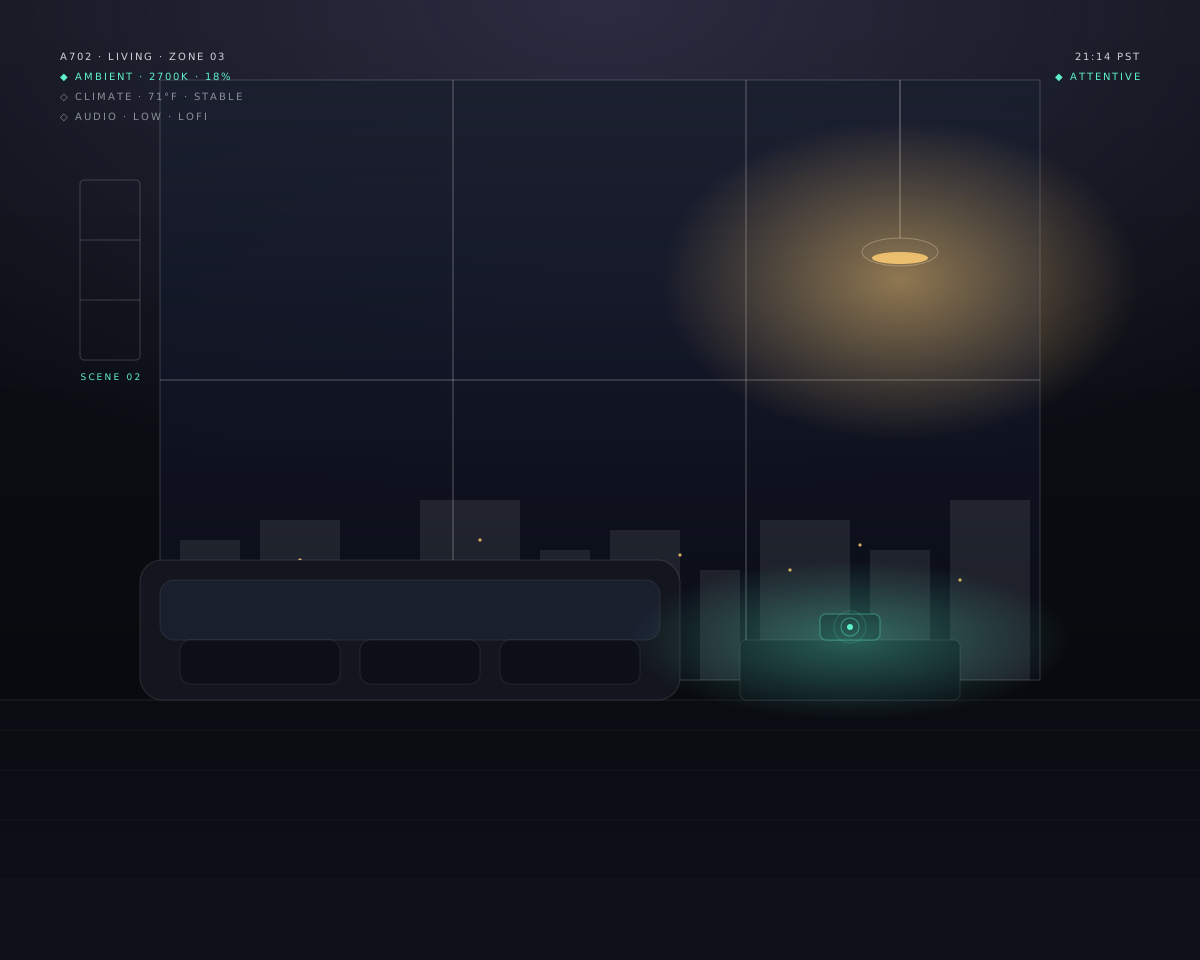
Vegas estate living room with ambient lighting
Living · Henderson, NV3 zones, 1 conversation.
Ambient

Whole-home voice

01

Natural conversation in every room — no wake-word ceremony, no scripted phrases. We deploy a layered approach: a single coherent voice across the home, with on-device handling for sensitive spaces (bedrooms, offices) and cloud handling where you want richer reasoning.

Ambient AI

02

Context-aware presence: who's home, what's the routine, what time of day, what's coming up on the calendar. Your house responds in the background — adjusting climate, arming areas, queuing music, opening shades — without anyone tapping anything.

Adaptive scenes

03

Lighting, climate, audio, and shading shift with the time of day, the calendar, and the people in the room. We design the scenes to feel natural at 7am and at 11pm — and to disappear entirely when guests are over.

Audio that follows

04

Music, podcasts, calls — they move with you between zones. Pause when you walk into a meeting space. Resume when you walk out. Volume tunes to ambient noise and time of day automatically.

Energy intelligence

05

Solar, batteries, HVAC, and shading orchestrated together. Predictive pre-cool before peak rates. Vegas-rated thermal logic that anticipates the afternoon. Real savings on a real Vegas utility bill — typically 15–30%.

Security with judgment

06

Camera-aware perimeter that distinguishes the gardener from a stranger. Intent detection rather than motion alerts. Soft notifications for the things you should know about, and silent escalation for the things you should be told about right now.

§ 03Where we typically come in

Four shapes of residential engagement.

Most homes don't need new hardware. They need the layer of judgment above the hardware. Below: the four scenarios we plan for explicitly, in roughly the order we see them.

  1. Case · 01Architect-collab

    New construction

    Designed in from day one. We sit at the table with the architect, the builder, and the AV/network firm, so the AI layer is part of the home rather than bolted on after. Cleanest outcome, smallest cost premium.

  2. Case · 02Most common

    Estate retrofit

    Most of our work. The home already has Lutron, Crestron, KNX, or a Home Assistant mix; the hardware is fine. We add the orchestration and the AI brain, and quietly retire the half-dozen apps you never quite trusted.

  3. Case · 03Partner-friendly

    Working with your AV firm

    Your existing AV partner usually knows your home better than anyone. We come in as the AI specialist, not the replacement. We coordinate scope, divide labor, and bill in whatever shape works for the project.

  4. Case · 04Multi-site

    Vacation property / multi-residence

    Occupancy-aware behavior across multiple homes — the property knows whether you're arriving in 30 minutes or in three weeks, and acts accordingly. Secure remote access, shared-staff coordination, single panel of glass.

§ 04Privacy by design

The home gets smarter. The data stays yours.

Our clients tend to be the kind of people who'd rather not have their living rooms train someone else's chatbot. We agree. Privacy isn't a marketing line on this page — it's a constraint we design against from the first conversation.

  • On-device first

    Voice and vision processing happens locally wherever the hardware allows. The cloud is consulted only when the request needs the larger reasoning of a hosted model — and only through your private gateway.

  • Private model gateway

    If the cloud is involved, it goes through your dedicated gateway. Your home's data is never used to train someone else's general-purpose AI. That's not a footnote in the terms of service — it's the architecture.

  • You own the recordings

    What gets recorded, retained, and for how long is your decision. Most of our deployments retain nothing by default for non-event audio and video — the system listens and acts in the moment, without writing it down.

  • Audit trail you control

    Every action the home took is logged in a private journal you can read. Who arrived, what got armed, what scenes ran, what alerts were sent — yours to query, yours to delete.

§ 05Residential FAQ

Honest answers about home AI work.

Questions estate owners and their architects, builders, and AV partners ask us most often.

  • Smart-home installers wire devices. We design intelligence. The hardware your home already has — lighting, HVAC, audio, cameras, locks, blinds — usually doesn't need to be replaced. What's missing is the brain that makes it all behave like a single attentive system instead of nine different apps.

  • Yes. We are deliberately platform-agnostic and integrate at the standards layer (Matter, KNX, BACnet, Home Assistant, vendor APIs). Your installer's work is honored — we sit on top of it, not in place of it.

  • We strongly prefer it. Your existing AV partner usually knows your home better than anyone — we work with them. We are happy to coordinate, scope, and bill in whatever shape works for the project.

  • Privacy is the design constraint, not an afterthought. Voice and video processing happens on-device wherever possible. Cloud calls are made through private gateways with full audit trails. You decide what is recorded, what is retained, and for how long. We will never sell or share your data.

  • Both. New construction is easier — we design it in from day one. Existing homes are more common — we add the intelligence layer to the systems you already have. Most of our work is the second kind.

  • Most of the work is on the network and the orchestration layer, which means very little wall-opening or ceiling-cutting. A typical engagement is a few days of on-site work spread across two or three weeks, plus a tuning period.

  • Yes. Multi-property work is something we plan for explicitly — including occupancy-aware behavior, secure remote access, and shared-staff coordination across locations.

  • Yes — and it's worth having. Software needs occasional updates, models drift, household routines change. We offer a quiet monthly retainer for ongoing care; many estates pair it with their existing AV maintenance contract.

Engagement

The first
conversation
is free.

Tell us about the work that's eating your nights and weekends. We'll come back within one business day — with an honest read on whether AI fits, what it'd actually cost, and where to start. No sales-call ambush, no 12-month contract. If it's not the right move, we'll say so.

We respond within 1 business day · No spam, ever